Posts Tagged ‘NCAA’

Can Our Sports be Fixed?

Wednesday, September 30th, 2026

By Bob Gaydos

4AB887F8-13B6-472F-A31F-F215D726D718   When I read that the U.S. Senate had voted overwhelmingly to fix college sports, my first reaction was, “Great!”

   As an old sports editor, I had given up trying to figure out portals and transfers and where a player was this year and what conference that school was in, how many schools were now in the Big Ten and how much a college athlete could earn by having his or her face plastered on some product.

    It used to be that a standout high school athlete could “earn” a college education by getting a full scholarship to play football or basketball or whatever sport that college emphasized. That was the payoff. And the opportunity to let the pro teams see you play. But with expanded playoffs, TV coverage, legalized sports gambling and the increased flow of money, colleges were cashing in. Football coaches especially were cashing in for multi-million-dollar contracts and athletes were left hoping to be a top draft choice in the NFL or NBA. They complained that they weren’t sharing in the profit. The free ride was no longer enough. They sued and won.

      Now, this is mainly a football and basketball issue because those professional sports use colleges as their minor leagues. Soccer is also affected. Baseball has its own expansive minor league farm system to develop young players. Football and basketball depend on the colleges.

       Back to the Senate. Seventy-seven senators voted to set limits on college transfers, set standards on how players could get paid and to protect the National Collegiate Athletic Association from anti-trust lawsuits. This bipartisan (and historic) agreement immediately raised questions in some quarters about whether senators should even be bothering about such things and from civil rights groups that the legislation unfairly penalized black athletes by limiting their mobility and earning potential.

       So I paused to take a second look and see what I missed.

       Beats me. The current system really is a revolving door with young athletes constantly shopping for a college to transfer to so they could get more playing time and make a better impression and maybe make more money. That makes it difficult for coaches to plan for next season. To discourage school shopping, transfers were usually required to sit out a season at their new school. The new legislation would reinstitute that feature.

     The bill is called the Protect College Sports Act. I don’t know if it can protect it or save it. Or even if it can be fixed. In fact, the bill may not get passed because the House of Representatives won’t be back in session until after the November election and that may be a lame duck Congress full of members who will not be there in January and may not care about fixing college sports.

    This college sports merry-go-round is only one of my gripes with the current sports scene. Baseball puts a runner on second base to start the 10th inning so people can get home from the ballpark quicker. Arguing with the umpires is now a lost art thanks to instant replay. Infielders have to make sure they don’t step on the outfield grass.The statistics fanatics are mesmerized by how fast the baseball gets off the bat into the outfield or into the stands rather than the fact that the best hitter on the team struck out 100 times last year. Pitchers get a pat on the back when they last six innings.

    I think hockey is still OK, but basketball is a run-and-gun three-point festival. And all sports are now captive to the legalized gambling addiction that lets “fans” wager on individual moments, not just who will win or lose. And that also brings temptations for players and those for whom the joy of winning is secondary to the joy of cashing in.  And while I’m at it, it’s probably not a coincidence that both the New York Times and Washington Post eliminated their sports departments. 

    When I moved out of sports, I eventually became an editorial writer for a daily newspaper. As such, I came to think of my job as trying to connect the dots for readers. A generous friend recently thanked me for “providing a compass” on current events.

   Sorry, Nollie, when it comes to whether or not sports, college or professional, can be “fixed,” I’m lost.

        ***

Editor’s note:  Please feel free to share any suggestions you might have about how sports on the college or professional level can be fixed.
       

What the Heck Happened to Sports?

Wednesday, May 1st, 2024

By Bob Gaydos

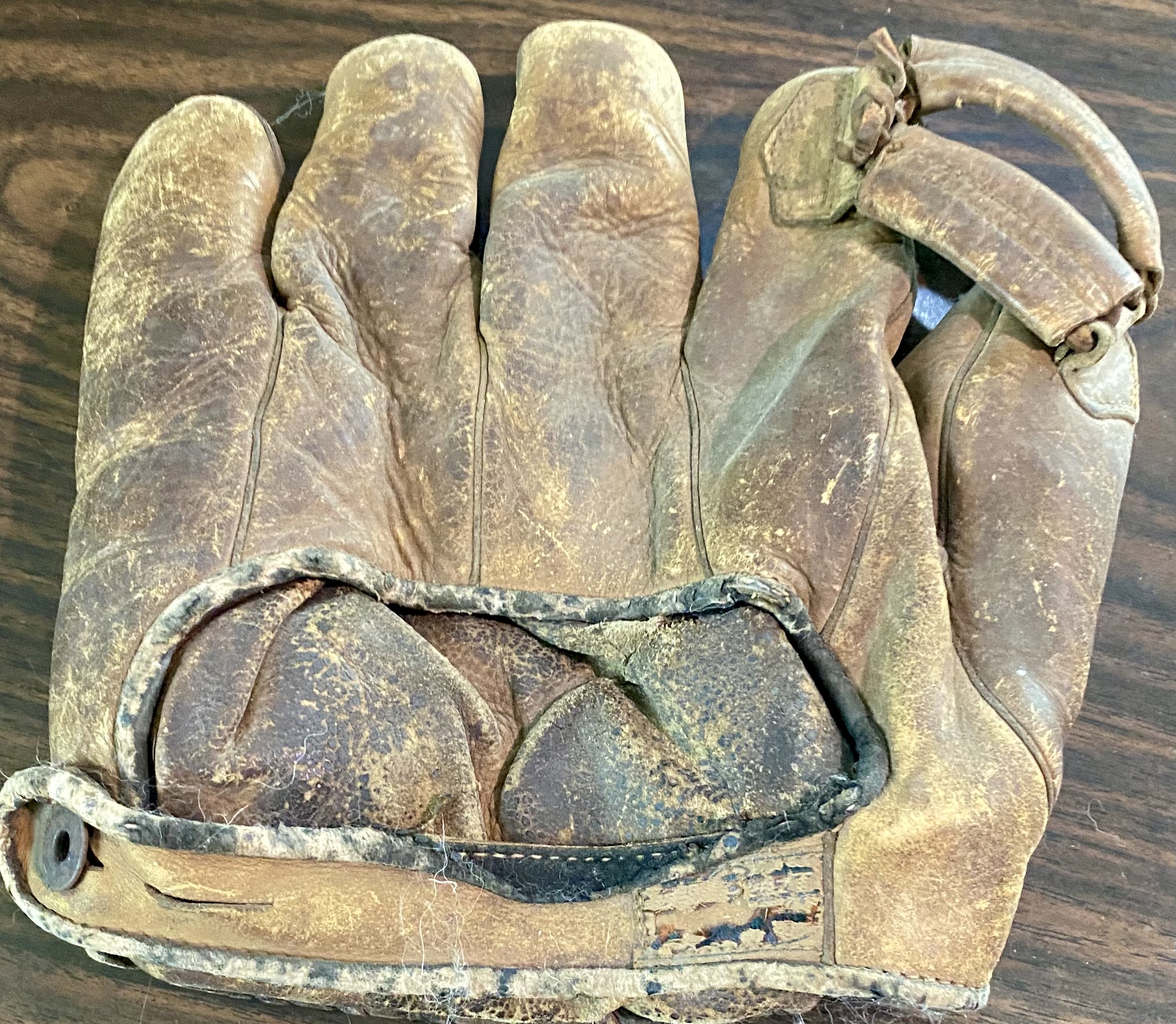
My Little League mitt, circa 1951.

My Little League mitt, circa 1951. RJ Photography

Ruminations of an old sports editor:

     The daily grind of following and writing about the Trump/MAGA assault on our democracy can be tiring, so I sometimes turn to sports in search of a break.

      For example, former major league ball player Art Shallock celebrated his 100th birthday April 27. The one-time Yankee pitcher is said to be the oldest living major leaguer.

   Perhaps his most notable moment in baseball history is when he replaced 19-year-old Mickey Mantle on the Yankees roster when the future Hall of Famer was optioned to Triple A for more seasoning. That was in 1951, which is the same era in which I used the glove pictured with this column to play center field for my Little League team. So I’m an old sports editor in both senses of the word.

      Shallock won a few games with the Yankees, collected three World Series rings and never made more than $5,000 a year, but he seems content with his journey.

       Less content recently is Yankees manager Aaron Boone. It’s not enough that he’s going through a divorce, but he recently was ejected from a game because a fan sitting directly behind Boone and the Yankees dugout was harassing the umpire.

     Even when everyone pointed out that Boone hadn’t said anything, the ump still tossed him, saying, “The manager’s in charge.”

      The umpire, Hunter Wendelstedt, stuck by his guns and his ego and the Yankees appealed and, surprise! MLB actually said the ump was wrong and will be penalized. 

       I’d say a couple of weeks without pay for this dumb stunt and a refresher umpire school. The device that charts balls and strikes said he also missed 68 percent of the strikes thrown in the game. A few other umps could use refreshing, too. Robots are looming.

      In another recent case of a major sports entity surprisingly admitting it messed up, the NCAA gave Reggie Bush his 2005 Heisman Trophy back, conceding that times had changed.

        Indeed.

        Bush was given then denied the award for his efforts as a running back at Southern California because his family had benefited financially (trips and gifts) from his success, a big no-no for the world of amateur college athletes. 

         Well, that was then and now is apparently now and today’s college athletes receive lucrative payments for use of their likenesses because colleges have made millions from their efforts, much of which also went to coaches, but not to the athletes (who were supposedly getting a free college education.)

      So, traditional college conferences are now scrambled to get richer TV contracts, coaches and colleges are making millions, college athletes now go where they can get the best contract, the NFL avoids establishing a farm system like baseball did and Reggie Bush is finally getting his Heisman.

     Further signaling the steady demise of amateur athletics, medal winners are apparently going to be awarded cash prizes for the first time at the Paris Olympics this summer. Ain’t capitalism great?

     Oh, and lest we forget, you can now legally bet on pretty much anything in any sport, while the game is in progress, in (sort of) full confidence the athletes aren’t doing the same. 

    I patched together this sports report mostly from social media because, if you haven’t noticed, traditional — to wit, newspaper and magazine — sports reporting has been replaced by sports personalities with opinions “reporting” on TV. 

       Sports Illustrated, having laid off most of its staff, was recently saved from oblivion when some company said it would keep the onetime sports standard bearer going as a monthly, not a weekly. 

      No thanks. Not when the magazine has lost its immediacy and stable of top sports writers that once included Frank DeFord and the incomparable Jim Murray.

      Plus, The New York Times actually eliminated its sports staff, reassigning reporters to who knows what and hiring something called The Athletic, whose writers apparently know a lot about WAR and leaving the park velocity in baseball and whatever conspiracy theory potential Jets quarterback Aaron Rodgers is currently spreading.

     Red Smith they are not (when he was writing about sports with The New York Herald Tribune as well as The Times.)

      Nor are they Al DeSantis in Middletown, N.Y., Joe Gross in Annapolis, Md., John Fox and, well, me in Binghamton, N.Y., or Dick Young, Jimmy Cannon and Mike Lupica in New York City or, for that matter, the Newark Star-Ledger’s Jerry Izenberg, who once lent me his typewriter at Yankee Stadium so I could write a piece about Orioles pitcher Jim Palmer, whom I had just interviewed while he was sitting in a whirlpool bath. Yes, naked.

      Guess those were the good, old days.

PS: Thanks to just-retired John Sterling, longtime Yankee radio broadcaster, for all those marvelous home run calls. “It is high! It is far! It is gone!“ A sterling effort.

rjgaydos@gmail.com