Posts Tagged ‘Shawn Dell’

Shawn’s Painting of the Week, 2/9/10

Monday, February 8th, 2010

montgomery-watertowerPainting of the ubiquitous watertower in Montgomery. This pastel painting is one of a series of paintings depicting Montgomery on it’s 200th anniversary. Celebrate the bicentennial with me and Carrie Jacobson at our art show at Wallkill River School and Art Gallery on March 13, 5-7pm. www.WallkillRiverSchool.com

Shawn’s Painting of the Week, 1/25/10

Monday, January 25th, 2010

candy-dish-small

This pastel painting is a still life of licorice candies. It was painted during my Thursday evening pastel studio class at Wallkill River School in Montgomery. I set up several still lifes for participants to choose from, then demonstrate a specific technique. This demo was about using complementary colors to create color harmony. Anyone can drop in and try it out. It’s a fun class with a fun, encouraging group of regulars! www.WallkillRiverSchool.com

Put Roads on No-Salt Diet

Monday, January 18th, 2010

By Shawn Dell Joyce

     According to the National Research Council, New York uses more salt than any other state, weighing in at 500,000 tons per year. The state Department of Transportation requires a road-salt application rate of 225 lb. per lane-mile for light snow and 270 lb. per lane-mile for each application during rapidly accumulating snow.

      When you consider that there are approximately 6,000 miles. of paved roadways near state watersheds, you begin to see how all that road salt adds up. Some roads may get up to 300 tons of road salt per lane-mile each year. Recently, many scientists have begun to study the effects of so much road salt on ecosystems, water quality, public health and road quality. Here are a few things you should know before your break out that sodium chloride:

 — Salt destroys soil structure by killing some soil bacteria. This allows more soil to erode into streams, taking the salt with it. Salt erosion contaminates drinking-water supplies to levels that exceed standards.

— Salt doesn’t evaporate or otherwise get removed once applied so it remains a persistent risk to aquatic ecosystems and to water quality. Approximately 55% of road-salt runs off with snow melt into streams, with the remaining 45% infiltrating through soils and into groundwater aquifers, according to a 1993 study.

— Salt slowly kills trees, especially white pines, and other roadside plants. The loss of indigenous plants and trees on roadsides allows hardier salt-tolerant species to take over.

— Salt can change water chemistry, causing minerals to leach out of the soil, and it increases the acidity of water, according to Dr. Stephen Norton, a professor of Geological Sciences at the University of Maine.

— Salt cracks animal paws making house pets particularly susceptible.

— Road salt seeping into drinking water changes its flavor, and supplies the excess dietary sodium associated with hypertension. 

— Salt corrodes metals like automobile brake linings, frames, and bumpers, and can cause cosmetic corrosion. To prevent this corrosion, automakers pay almost $4 billion per year.

— Salt can penetrate concrete to corrode the reinforcing rods causing damage to bridges, roads and cracked pavement.

   Canada is considering classifying conventional deicers as toxic substances under the Canadian Environmental Protection Act. California and Nevada restrict road-salt use in certain areas to reduce damage to roadside vegetation. Massachusetts is using alternative deicers to prevent contamination of drinking water. New York State is considering doing the same to protect New York City’s watershed. 

      There are alternatives to sodium chloride that are relatively harmless to the environment and still get the job done. Calcium magnesium acetate (CMA) and potassium acetate (KA) are two chloride alternatives currently available. They are much more expensive than road salt, but if you factor in the loss of wildlife, soil erosion, water quality and corrosion, these alternatives start to look like a real bargain.

For home use, there are many alternatives with varying degrees of environmental safety.

— Urea is often used for deicing as it melts ice and is not corrosive, making it popular for airport runways. Urea can also cause algae blooms in waterways, so it isn’t a good choice near streams.

Alfalfa meal is a natural fertilizer that actually melts the ice, provides traction and won’t harm the environment. It is different than pelletized alfalfa sold in feed stores, look for meal in local garden centers.

— The greenest choice at home is snow cleats on your shoes and a good workout with a snow shovel instead of chemical deicers. Got a bad back? Pay the neighbor’s teenager to do the job for you and keep the money flowing in your local economy.

 Shawn Dell Joyce is an award-winning columnist and founder of the Wallkill River School in Montgomery, N.Y. shawn@zestoforange.com

Shawn’s Painting of the Week, 1/19/10

Monday, January 18th, 2010

crabtrees-mill-small

Pastel painting of Crabtree’s Mill in Montgomery.

Shawn’s Painting of the Week, 1/12/10

Monday, January 11th, 2010

crossing-the-bridge_edited-11

The view of Montgomery as you enter through Ward’s Bridge. The pastel painting is the newest in a series of paintings celebrating Montgomery’s bicentennial. A portfolio of prints of these paintings is available to benefit the Montgomery Historic Museum. www.ShawnDellJoyce.com

The Story of Stuff

Tuesday, December 29th, 2009
By Shawn Dell Joyce
 
Most of us are surveying the damages right now; all the packages are unwrapped and scattered under the tree, the credit cards are maxed, and we’re exhausted. Now we have to decide where to put all the new stuff. Especially those new gadgets we just had to have, and waited in line during the wee hours after Thanksgiving at the box stores.

“Less than 1 percent of all the consumer goods bought and sold during the holiday season will be in use six months from now,” says Annie Leonard in “The Story of Stuff,” a short film produced by Free Range Films and available free online at www.storyofstuff.com .

“The Story of Stuff” chronicles the life of consumer goods from the “cradle to the grave,” and offers an alternative vision to our consumerist culture. Leonard points out that we have lost our identities as “mothers, farmers, firemen, teachers, and become consumers.”

Indeed we are defined by what we consume, and are targeted demographically by stuff-peddlers from infancy to old age. In our culture, we feel awkward if we don’t have “the right stuff,” fashionable clothes, flashy “bling,” and the newest techno-gadget. What we don’t often see is the consequences of our national addiction to stuff.

We see more advertisements in one year than our grandparents did in their whole lifetimes. We consume twice as much as they did as a result. Our houses are twice as big, our waistlines are bigger, and our savings accounts are considerably smaller.

Melissa Everett, executive director of Sustainable Hudson Valley defines “sustainable living” as “not filling a spiritual need with a material thing.”People buy stuff for many reasons, but for a substantial segment of our population, shopping is an addiction.

“Compulsive shopping or spending can be a seasonal balm for the depression, anxiety and loneliness during the December holiday season,” says Professor Ruth Engs of Indiana State University.

If living simpler is one of your new year’s resolutions, here are a few suggestions:

— Author and therapist April Lane Benson who wrote “I Shop, Therefore I Am,” recommends that before you make an impulse purchase, ask yourself “Why am I here?,” “How do I feel?,” “Do I need this?,” “What if I wait?,” “How will I pay for it?” and “Where will I put it?”

— Buy used or borrow things from friends and neighbors before buying new.

— Repair and mend rather than replace, upgrade computers rather than buying new ones.

— Develop habits of zero waste; use both sides of the paper, carry your own mugs and shopping bags, get printer cartridges refilled instead of replaced, compost food scraps, avoid bottled water and other over packaged products.

— “The average person in the U.S. watches TV for more than four hours a day,” notes the Story of Stuff, “Four hours each day are filled with messages about stuff we should buy. Those are four hours that could be spent with family, friends and in our community.”

Turn off the TV, let go of stuff, and step outside and embrace our local community.

Shawn can be eached at shawn@zestoforange.com.

Shawn’s Painting of the Week, 12/29/09

Tuesday, December 29th, 2009

downtown_businesses


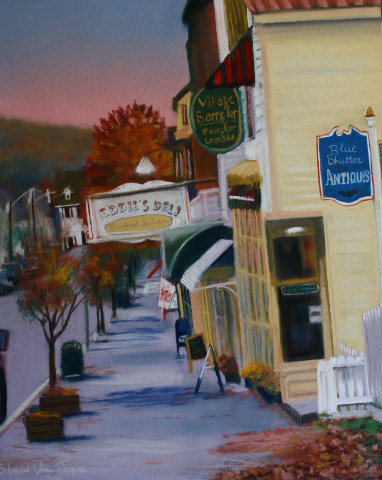
Downtown Montgomery. This is part of a series of paintings in honor of Montgomery’s Bicentennial. Work can be seen in March at the Wallkill River School or purchased online at www.ShawnDellJoyce.com

Shawn’s Painting of the Week 12/21/09

Monday, December 21st, 2009

iron-cafe1


Iron Cafe, a pastel painting of the corner of Clinton Street and River Road in the historic Village of Montgomery. See more of my work at www.ShawnDellJoyce.com

Finding Joy Without the Price Tag

Monday, December 21st, 2009

By Shawn Dell Joyce

New York is near the top of the list of states in terms of depressed residents. Much of this holiday malaise can be traced to a sagging economy and unrealistic holiday expectations. A parents’ group, the Campaign for a Commercial-Free Childhood, wrote letters to 24 leading toy companies and retailers to state their concern about ads aimed at kids. These parents expressed dismay that they can’t afford the pricey toys that toymakers are heavily advertising to children, and said children feel diminished when they don’t get those pricey toys.

Sometimes it’s hard to believe that we are descended from settlers’ children who rejoiced at receiving a penny and a stick of candy as their main holiday gifts. In the 1800’s, people earned $1,500 per year and would have had one nice set of clothes for church, and one shabby set for daily life. They worked twice as hard for a simple diet because they had to grow most of what they ate. Over the course of 200-plus years, we have grown an average of 4 inches taller and 20 pounds heavier, our houses have more than doubled in square footage, and we no longer delight in a penny and a stick of candy.

We need to reclaim our holidays as times of family togetherness and joy, no matter what shape the economy is in. Even if you don’t celebrate the Christian holiday, or the Jewish Hannukah, or African Kwanzaa, you can still celebrate a “Secular Sabbath,” in the words of New York Times food columnist Mark Bittman. A secular Sabbath is a break from email, cell phones, television, and all the other distractions of modern living that keep us alienated from each other.

“You need not be elderly to remember when we had no choice but to reduce activity on Sundays; stores and offices — even restaurants — were closed, there were certainly no electronics, and we were largely occupied by ourselves or our families,” writes Bittman.

Here are some inexpensive  ways to get more joy from the holiday season:

—  Find joy in the mundane moments. Notice the details of the season, new fallen snow, laughing children off from school, glittering icicles and the sparkle of a lit tree.

— Avoid comparing your decorated house with your neighbors or your co-worker’s holiday plans with your own and so forth. Instead of comparing, which is almost always unfavorable, be genuinely glad for your fellows, delight in their joy, and you in turn will feel greater satisfaction.

— Bring holiday cheer to neighbors by baking cookies and then delivering them. No neighbors? Drop in at the Montgomery Nursing Home or another near you.

— Put gratitude in your attitude. Start your holidays off with a gratitude list noting all the wonderful tangible and intangible blessings you have in your life. Counting your blessings will keep you focused more on what you do have

— Keep the spirit of the holidays in your heart all year. Remember to give often and generously. Make volunteerism part of your daily routine. Research indicates that both the giver and the receiver of a good deed get an endorphin boost from the act.

Shawn Dell Joyce is an award-winning columnist and founder of the Wallkill River School in Montgomery. Shawn@zestoforange.com 

It’s Really Healthy to Give

Tuesday, December 15th, 2009

By Shawn Dell Joyce

We have all heard the old saying that it is better to give than to receive, but recently, a new study proved scientifically that the real key to happiness is generous giving. In times of economic stress, it is even more important because giving actually builds your wealth, and the wealth of the local community.

People who give charitably are 43 percent more likely to say they are “very happy” than non-givers, while non-givers are three and a half times more likely to report they are “not happy at all,” notes Arthur Brooks in his new book, “Who Really Cares: The Surprising Truth about Compassionate Conservatism.”


In a surprising turn, Brooks proves that giving also increases personal and well as national prosperity. Brooks quotes a survey that controlled for education, age, race and all the other outside explanations for giving and income increases. The survey proved that a dollar donated to charity was associated with $4.35 in extra income for the giver. $3.75 of that was due to the dollar given to charity, and the multiplier effect it has in the local economy.


But we really don’t need a study to show us how giving benefits our local community.  Many of us lot our jobs and/or homes this year. In fact, one out of eight of our neighbors needs unemployment benefits, and one in four children relies on food stamps. If you are having a hard time getting into the holiday spirit because of reasons like these, it is especially important to give.  


         There are angels among us who do this every day, without fail, and regardless of the economy. I won’t embarrass them by using their full names, and it really isn’t important “who” so much as “how.”


Take grocery clerk Karena who volunteers at the Montgomery Food Pantry and organizes food drives in her place of employment. She strengthens a safety net for 181 local families, and stands between them and hunger. Not a wealthy person herself, she manages to make a huge difference in people’s lives by giving her time and energy.


Edie is a local farmer who is always there when 4H or other children’s organizations need help. Her service to the community has furthered many of our youth’s understanding of our agricultural heritage.


Marion is an octogenarian who (almost single-handedly) has preserved much of Montgomery’s history. Without her vast volunteer hours; stories and treasures of our recent past would be lost to future generations.


Bob is a volunteer fireman who also volunteers his time and energy to at least three other nonprofit community organizations. Volunteer firemen have to be ready on a moment’s notice to place their life on the line to serve our community.


Finally there’s Lily, a senior who volunteers much of her time and resources to local nonprofits. I happen to run one that benefits from her generosity. She also doesn’t have a vast fortune, but still manages to give of herself through hundreds of random acts of kindness in a single day.


           Start by listing at least 25 things you are grateful for, from the food in your belly to the clothes on your back. Then follow in these folk’s footsteps and find your way to make Orange County a better place.

Shawn@zestoforange.com