Archive for the ‘Shawn Dell Joyce’ Category

How to Create Local Economic Impact

Tuesday, January 26th, 2010

By Shawn Dell Joyce

Rep. Maurice Hinchey has made a startling statement — that the concentration of wealth in the U.S. is the same today as it was in the 1920’s with the highest concentration of dollars in the hands of the wealthiest few. It seems that most of those wealthy hands don’t live in the Wallkill Valley.

We must create our own economic stimulus if we are to weather the current economic climate. One way that we can all do this is by interweaving our businesses and households with other local businesses and farms.  What I mean by this is generating economic impact in our hometowns by keeping our money flowing in the local economy, and passing through local business after local business.
One way we do this in Montgomery is through a band of village businesses called Montgomery Business Association. We work together to bring cultural tourism to our quaint historic village. We also look for ways to connect our businesses and lower our operating costs.

For example, I’m the director of the nonprofit Wallkill River School. We are working with Ms. Claire’s Musical Cupboard on summer programs for children. We will share the cost of a locally-printed brochure which advertises both businesses.
The way this act generates local economic impact is that $100 comes in to Ms. Claire’s Musical Cupboard from a parent enrolling their child. Part of that $100 pays the teacher who lives locally, part goes to pay rent to a local landlord, and toward advertising that helps benefit Wallkill River School by lowering our advertising costs as well. Net result, several local businesses have benefitted by one parent buying local.

Looking at a larger scale, I traced the economic impact of the Wallkill River School on our local community.  Last year, we had 806 adult enrollments in 131 classes, and 174 child enrollments in 30 classes bringing in a gross of $77,156. Additionally, we offered a comprehensive free teen art class program offering 20 classes to 194 local teen enrollments, and a free Senior’s class serving  780 drop-ins per year almost equaling attendance in our paying classes.

Of the $77,156 brought in by art classes,  half was paid out to the local artists who taught the classes. The other $38,500 goes toward paying staff salaries; both employees live in the community and pay local property taxes.  And part went to paying utility bills, insurance (through a local broker) and refreshment costs.  The gallery part of our business pays the rent which goes to our local landlord and patron, Ed Devitt.
We created economic impact in our home community by partnering with James Douglas Gallery for framing, and sending him thousands of dollars of framing business. We also generate business for a local art supply store, Newburgh Art Supply. We partnered with several local farms including joining the Share of the Harvest Program at Sycamore Farms to provide local foods picnic lunch for our summer outdoor painting class and for still life objects, Hoeffner’s Farm for seasonal decorations like cut flowers, pine drapes and wreaths, mums, etc.

Another way we found to generate economic impact is to partner with several local restaurants including Wildfire Grill, Ward’s Bridge Inn, and Iron Café to provide lunches for our classes generating more than $3,000 in lunch revenues for these businesses. All together, our economic impact on this community was to pay out more than $80,000 to other local businesses and residents, creating a multiplier effect as they, in turn, support other local businesses and pay local taxes.
I hope our model of doing business gives you some ideas of ways that your business and family can also stimulate the local economy.  This is common sense stimulus, which, to me, makes more sense then handing over a massive federal debt to our grandchildren.

Shawn@zestoforange.com

Shawn’s Painting of the Week, 1/25/10

Monday, January 25th, 2010

candy-dish-small

This pastel painting is a still life of licorice candies. It was painted during my Thursday evening pastel studio class at Wallkill River School in Montgomery. I set up several still lifes for participants to choose from, then demonstrate a specific technique. This demo was about using complementary colors to create color harmony. Anyone can drop in and try it out. It’s a fun class with a fun, encouraging group of regulars! www.WallkillRiverSchool.com

Put Roads on No-Salt Diet

Monday, January 18th, 2010

By Shawn Dell Joyce

     According to the National Research Council, New York uses more salt than any other state, weighing in at 500,000 tons per year. The state Department of Transportation requires a road-salt application rate of 225 lb. per lane-mile for light snow and 270 lb. per lane-mile for each application during rapidly accumulating snow.

      When you consider that there are approximately 6,000 miles. of paved roadways near state watersheds, you begin to see how all that road salt adds up. Some roads may get up to 300 tons of road salt per lane-mile each year. Recently, many scientists have begun to study the effects of so much road salt on ecosystems, water quality, public health and road quality. Here are a few things you should know before your break out that sodium chloride:

 — Salt destroys soil structure by killing some soil bacteria. This allows more soil to erode into streams, taking the salt with it. Salt erosion contaminates drinking-water supplies to levels that exceed standards.

— Salt doesn’t evaporate or otherwise get removed once applied so it remains a persistent risk to aquatic ecosystems and to water quality. Approximately 55% of road-salt runs off with snow melt into streams, with the remaining 45% infiltrating through soils and into groundwater aquifers, according to a 1993 study.

— Salt slowly kills trees, especially white pines, and other roadside plants. The loss of indigenous plants and trees on roadsides allows hardier salt-tolerant species to take over.

— Salt can change water chemistry, causing minerals to leach out of the soil, and it increases the acidity of water, according to Dr. Stephen Norton, a professor of Geological Sciences at the University of Maine.

— Salt cracks animal paws making house pets particularly susceptible.

— Road salt seeping into drinking water changes its flavor, and supplies the excess dietary sodium associated with hypertension. 

— Salt corrodes metals like automobile brake linings, frames, and bumpers, and can cause cosmetic corrosion. To prevent this corrosion, automakers pay almost $4 billion per year.

— Salt can penetrate concrete to corrode the reinforcing rods causing damage to bridges, roads and cracked pavement.

   Canada is considering classifying conventional deicers as toxic substances under the Canadian Environmental Protection Act. California and Nevada restrict road-salt use in certain areas to reduce damage to roadside vegetation. Massachusetts is using alternative deicers to prevent contamination of drinking water. New York State is considering doing the same to protect New York City’s watershed. 

      There are alternatives to sodium chloride that are relatively harmless to the environment and still get the job done. Calcium magnesium acetate (CMA) and potassium acetate (KA) are two chloride alternatives currently available. They are much more expensive than road salt, but if you factor in the loss of wildlife, soil erosion, water quality and corrosion, these alternatives start to look like a real bargain.

For home use, there are many alternatives with varying degrees of environmental safety.

— Urea is often used for deicing as it melts ice and is not corrosive, making it popular for airport runways. Urea can also cause algae blooms in waterways, so it isn’t a good choice near streams.

Alfalfa meal is a natural fertilizer that actually melts the ice, provides traction and won’t harm the environment. It is different than pelletized alfalfa sold in feed stores, look for meal in local garden centers.

— The greenest choice at home is snow cleats on your shoes and a good workout with a snow shovel instead of chemical deicers. Got a bad back? Pay the neighbor’s teenager to do the job for you and keep the money flowing in your local economy.

 Shawn Dell Joyce is an award-winning columnist and founder of the Wallkill River School in Montgomery, N.Y. shawn@zestoforange.com

Shawn’s Painting of the Week, 1/19/10

Monday, January 18th, 2010

crabtrees-mill-small

Pastel painting of Crabtree’s Mill in Montgomery.

How to Eat Local in the Winter

Tuesday, January 12th, 2010

By Shawn Dell Joyce


OK, I’ll admit it. January often tests my commitment to eating local. I’m running low on things I canned, dried, or froze over the summer, and most farms are closed. Meanwhile, the grocery store produce aisles are brimming with ripe watermelons, peaches, grapes and other fresh produce flown thousands of miles from the tropics to our frozen black dirt. Why would anyone pass up this fossil-fueled abundance?


“My immediate answer,” says farmer and locavore Linda Borghi, “is to look deeply into the eyes of a five-year-old. What kind of world are we leaving them? It’s all about carbon emissions and your footprint. By eating as much as we can within a 100-mile radius (of our home) we are able to reduce our carbon footprint by close to 40 percent.”


While forty percent of your carbon emissions sounds like a lofty number, remember that about 30 percent of world carbon emissions are caused by burning rainforests for beef and biofuels, according to the Rainforest Fund. Add to that the 15 percent of emissions caused by the transporting produce thousands of miles according to the National Academy of Science, and Borghi’s estimate falls on the low side.


If you are looking for fresh greens, local meats and eggs, fruits and vegetables, here are the places I go to all winter.


      ·         Pennings Farm in Warwick has an indoor farm market on the weekends with many O.C. farmers including Kiernan Farm (Gardiner) offering organic, pastured beef,  Late Bloomer Farm (Montgomery) offering greens, local grains and flours, root vegetables, local cheeses, apples, wines, and many others. Hours are 11am-4pm on the weekends; www.penningsfarmmarket.com (845) 986-1059


·         Jones Farm on 190 Angola Road does a bustling business in the winter with the “largest gift store in the region,” according to co-owner David Clearwater. Their farm features fresh fall apples, homemade fudge, a bakery, gourmet foods, and many other goodies. Open 8am-5pm weekends, and until 6pm during the week. www.JonesFarmInc.com, (845) 534-4445.


·         Quaker Creek Store, 767 Pulaski Highway, Pine Island, (845) 258-4570, open Mon-Fri. 7am-6pm, Sat. 7am-4pm. Try their prepared foods like wonderful stuffed cabbage (local), pirogies with local potatoes and onions, Cajun Andouille with local ingredients.


·         Soons Orchards, 23 Soons Circle, New Hampton. Soons is probably famous for their pies, but you can find local garlic, vegetables, apples, pears, fresh ground peanut or almond butter, mixes for dips or soups, jars of salsa, jam and jellies, honey, and maple syrup, among other items. Open to the public 9-5:30 every day. www.SoonsOrchards.com, (845) 374-5471


·         Walnut Grove Farm in the Town of Crawford, offers frozen pasture raised organic beef, pork, chicken, bacon, pies and jars of jams and jellies by appointment. Ned Roebuck (845) 313-4855 www.WalnutGroveFarms.net


·         Blooming Hill Farm 1251 Route 208, in Washingtonville. Guy Jones and sister; Cindy Jones, offer many varieties of potatoes, squash, cold-hardy lettuces, and chards, root vegetables, onions, broccoli some fruits, eggs, Sat. from 9-2 through April.  782-7310 www.bloominghillfarm.com


·         W. Rogowski Farm, 327-329 Glenwood Road, Pine Island, 258-4423, has an organic farm stand open year round. You can currently find apples, pears, shallots, turnips, beets, garlic, onions (of course) potatoes, greens of many varieties including Asian, chili peppers, squashes, turnips, radishes, cabbages, dried beans, and processed things like jellies, honey, maple syrup, sugar and crème. Sat. from 9-2 until spring.  www.rogowskifarm.com


Shawn Dell Joyce is the founder of the Wallkill River School in Montgomery, and an author of “Orange County Bounty” local foods cookbook. Shawn@zestoforange.com

Shawn’s Painting of the Week, 1/12/10

Monday, January 11th, 2010

crossing-the-bridge_edited-11

The view of Montgomery as you enter through Ward’s Bridge. The pastel painting is the newest in a series of paintings celebrating Montgomery’s bicentennial. A portfolio of prints of these paintings is available to benefit the Montgomery Historic Museum. www.ShawnDellJoyce.com

Shawn’s Painting of the Week, 01/03/10

Monday, January 4th, 2010

amy-bull-christThis is a portrait of the late Orange County doyenne Amy Bull Crist. The portrait will be donated to the new educational center in her name being built on her family’s ancestral farm of Hill-Hold. I had only a photocopy of a photo to work from and am not sure I’ve captured her. I would love to hear what you folks think. Shawn@zestoforange.com
What’s Your Impact?

Monday, January 4th, 2010

 By Shawn Dell Joyce

 If you are making a list of New Year’s resolutions for 2010 that include things like losing weight, being healthier, spending more time with family, and reconnecting with friends, how about looking at it another way. Ask yourself instead, “What impact am I making on my family and community?”

No Impact Man asked himself this question and found himself on a year-long challenge of living lightly in New York City with his small family and leaving little or no environmental impact. His family’s experience has recently been turned into a documentary, a book, and an online challenge at www.noimpactproject.org.

Could you avoid buying anything new (besides local produce) for one week? The No Impact Challenge asks you to start by stopping shopping for new things. Instead, repair broken things, make something yourself, or find used items at garage sales, Freecycle.com or Craig’s List. With the time you save by not shopping, host a clothing swap party, or play date with your family.

When Beavan began his experiment he stockpiled his family’s trash for a week to figure out what disposable items they could stop consuming and throwing away without sacrificing their happiness or comfort. He sorted the garbage into categories; disposables used less than ten minutes, and more than ten minutes, and things that they could live without. He equipped each family member with their own reusable drinking cup, containers, utensils, cloth napkins, and reusable bags. After giving up all disposable products, their level of happiness and satisfaction actually increased.

Beavan and his family invested in a rickshaw as their main transportation in NYC. We live in a commuting suburb and most of us spend an average of 1,000 hours annually behind the wheel. What would you do with all that extra time if you found other transportation? Half the trips we take in cars are less than 2 miles away and could be done on bicycle, roller skates, or foot with the side effect of improving our health and reducing our waistlines. Many of our local villages like Montgomery have recently improved sidewalks, and taken steps to encourage walking and bicycling.

Beavan’s family went without electricity for their no impact challenge. While that is extreme for us, most of our children watch more than four hours of t.v. every day. What if we all turned the darn things off and went for a walk in one of the lovely open spaces like Walden’s new rail trail, or Montgomery’s Benedict Park? Our children would feel more connected to the land and the seasons, and suffer less advertising.

Ironically, most of the food that the Beavan family consumed was probably grown in our area and sold at the farmer’s markets in NYC. Eating local in the winter requires more thought and planning than buying prepackaged foods in the supermarket. Several local farms are open year round in our area like Blooming Hill Farm and Soon’s Orchards. If you eat lunch outside of the house, make it yourself in a reusable container. If you substitute things grown locally for imports on your shopping list, like apples for bananas, you keep money flowing in our local economy.

The final part of No Impact Man’s Challenge involves volunteering for local nonprofits. “The final stage was to me the most important,” blogs Beavan.”The final stage was not about conservation. It was about innovation. And it was in this stage that I met new people and made the most friends. It was here that the people were most excited. It was not about doing less harm. It was about doing more good. It was less about limits and more about possibility.”


Shawn Dell Joyce is an award-winning columnist and founder of the Wallkill River School in Montgomery, N.Y.  shawn@zestoforange.com

The Story of Stuff

Tuesday, December 29th, 2009
By Shawn Dell Joyce
 
Most of us are surveying the damages right now; all the packages are unwrapped and scattered under the tree, the credit cards are maxed, and we’re exhausted. Now we have to decide where to put all the new stuff. Especially those new gadgets we just had to have, and waited in line during the wee hours after Thanksgiving at the box stores.

“Less than 1 percent of all the consumer goods bought and sold during the holiday season will be in use six months from now,” says Annie Leonard in “The Story of Stuff,” a short film produced by Free Range Films and available free online at www.storyofstuff.com .

“The Story of Stuff” chronicles the life of consumer goods from the “cradle to the grave,” and offers an alternative vision to our consumerist culture. Leonard points out that we have lost our identities as “mothers, farmers, firemen, teachers, and become consumers.”

Indeed we are defined by what we consume, and are targeted demographically by stuff-peddlers from infancy to old age. In our culture, we feel awkward if we don’t have “the right stuff,” fashionable clothes, flashy “bling,” and the newest techno-gadget. What we don’t often see is the consequences of our national addiction to stuff.

We see more advertisements in one year than our grandparents did in their whole lifetimes. We consume twice as much as they did as a result. Our houses are twice as big, our waistlines are bigger, and our savings accounts are considerably smaller.

Melissa Everett, executive director of Sustainable Hudson Valley defines “sustainable living” as “not filling a spiritual need with a material thing.”People buy stuff for many reasons, but for a substantial segment of our population, shopping is an addiction.

“Compulsive shopping or spending can be a seasonal balm for the depression, anxiety and loneliness during the December holiday season,” says Professor Ruth Engs of Indiana State University.

If living simpler is one of your new year’s resolutions, here are a few suggestions:

— Author and therapist April Lane Benson who wrote “I Shop, Therefore I Am,” recommends that before you make an impulse purchase, ask yourself “Why am I here?,” “How do I feel?,” “Do I need this?,” “What if I wait?,” “How will I pay for it?” and “Where will I put it?”

— Buy used or borrow things from friends and neighbors before buying new.

— Repair and mend rather than replace, upgrade computers rather than buying new ones.

— Develop habits of zero waste; use both sides of the paper, carry your own mugs and shopping bags, get printer cartridges refilled instead of replaced, compost food scraps, avoid bottled water and other over packaged products.

— “The average person in the U.S. watches TV for more than four hours a day,” notes the Story of Stuff, “Four hours each day are filled with messages about stuff we should buy. Those are four hours that could be spent with family, friends and in our community.”

Turn off the TV, let go of stuff, and step outside and embrace our local community.

Shawn can be eached at shawn@zestoforange.com.

Shawn’s Painting of the Week, 12/29/09

Tuesday, December 29th, 2009

downtown_businesses


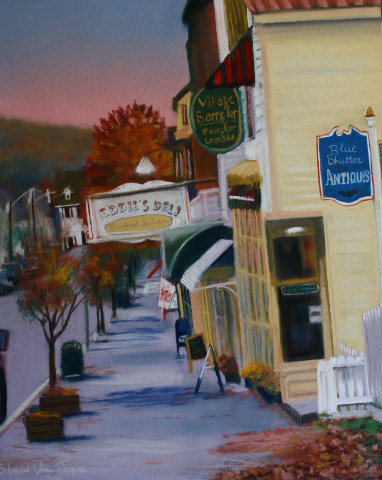
Downtown Montgomery. This is part of a series of paintings in honor of Montgomery’s Bicentennial. Work can be seen in March at the Wallkill River School or purchased online at www.ShawnDellJoyce.com